॥ शुभ विवाह ॥ · Hindu marriage biodata maker
A traditional
Hindu biodata for marriage
Rashi, Nakshatra, Gotra and Manglik status are already in the form, arranged the way elders read them. Fill in your details, choose a design with the right motifs, and download a print ready PDF. Your details stay on your own device.
Create Your Hindu Marriage Biodata
The horoscope fields are already below. Rename, reorder or remove any field to match your family's custom.
Personal Details
Family Details
Contact Details
Hindu Marriage Biodata Templates
These five designs are the ones Hindu families pick most. Each one carries the horoscope fields and the traditional motifs, and your details preview on every one of them free.
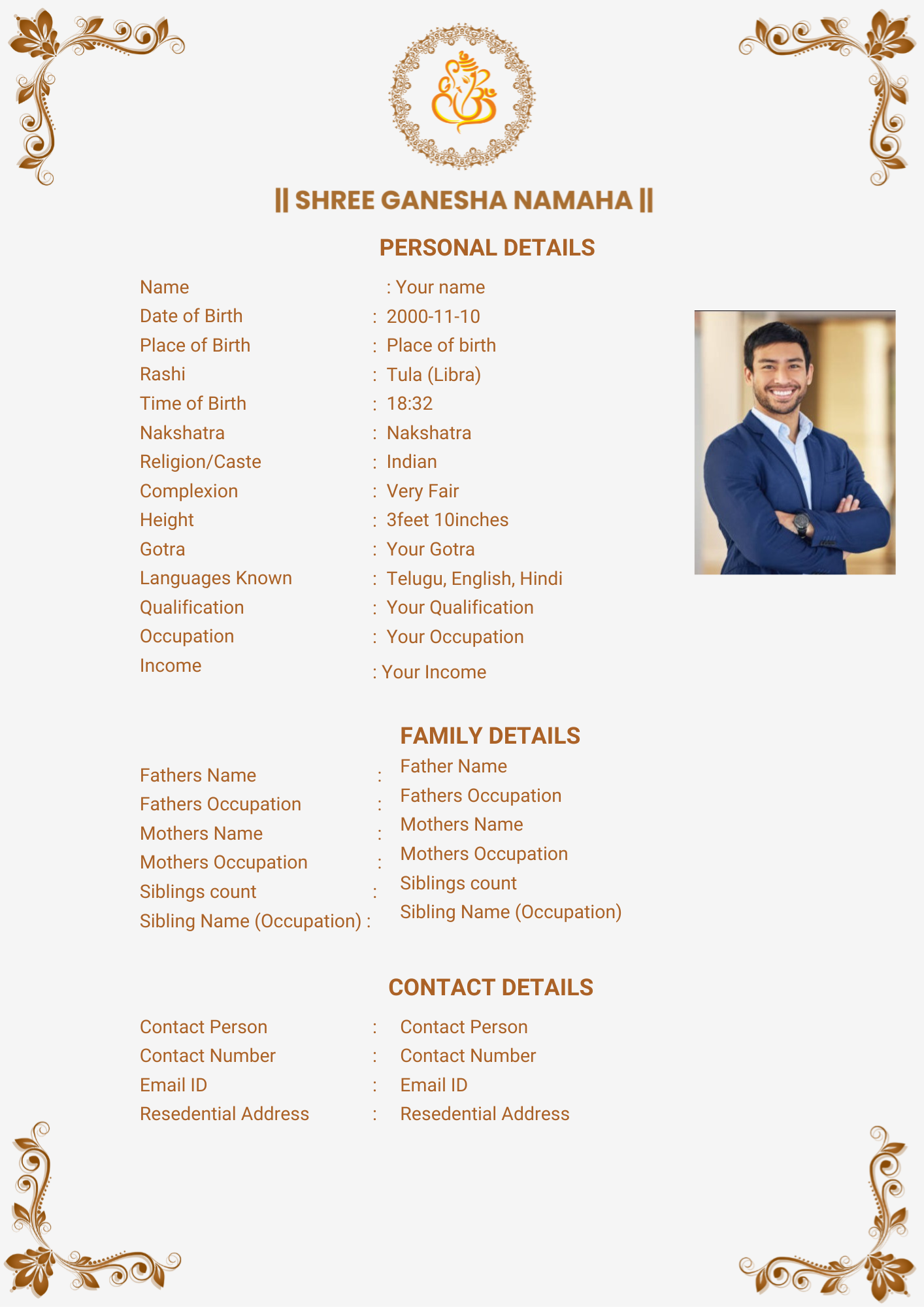
Chandan
Sandalwood cream with Ganesha
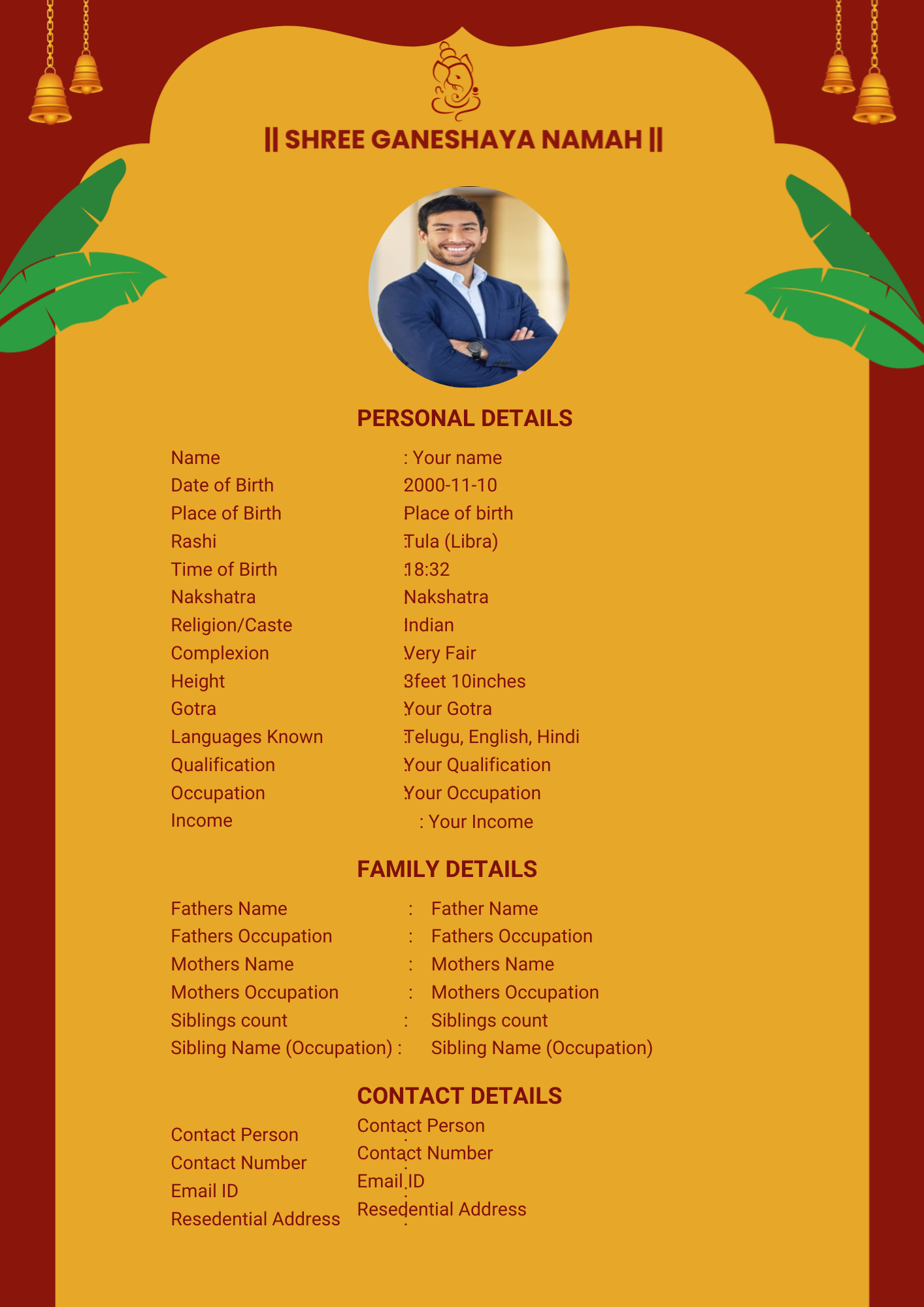
Sindoor
Deep red wedding card border
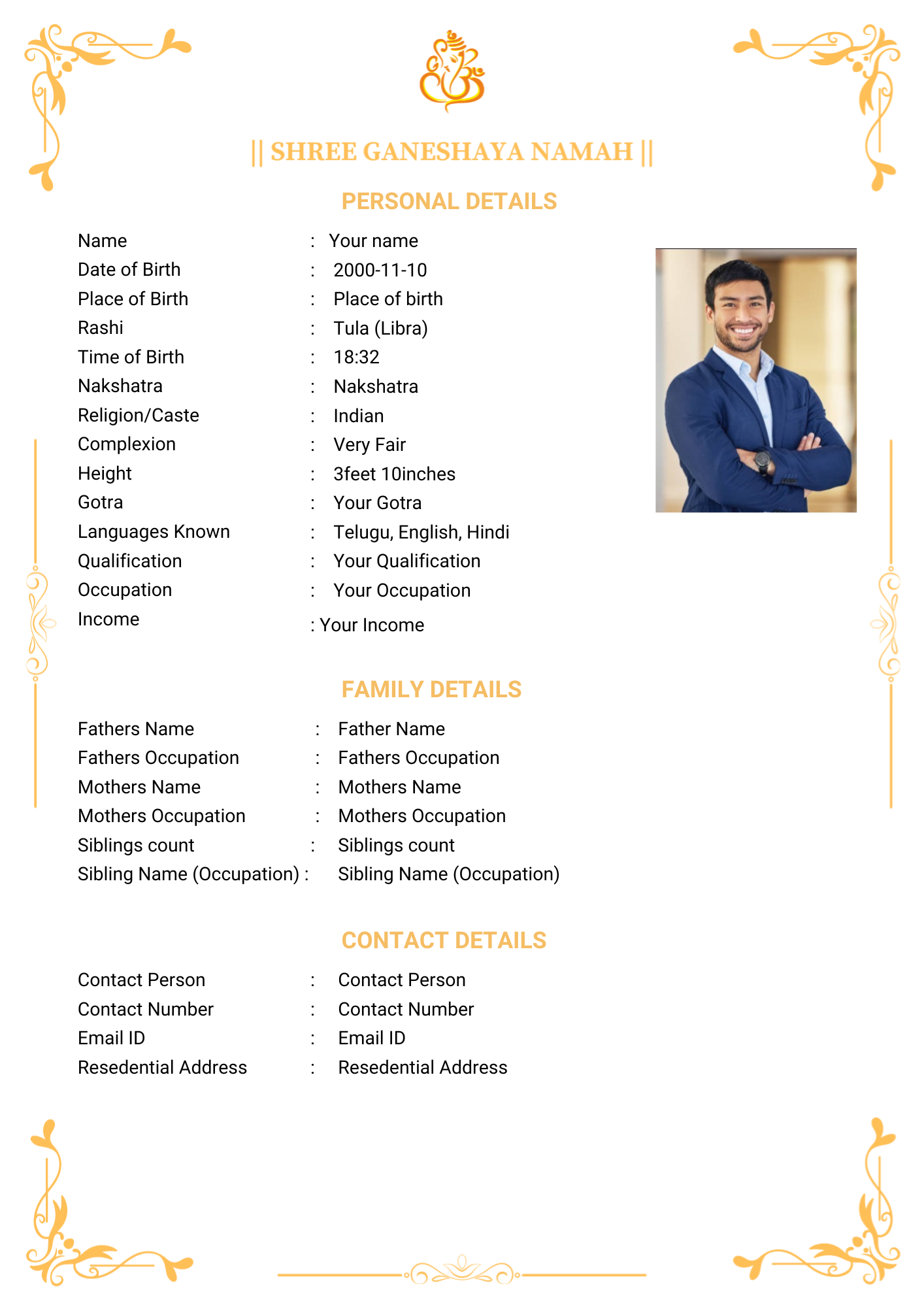
Marigold
Gold garland corners
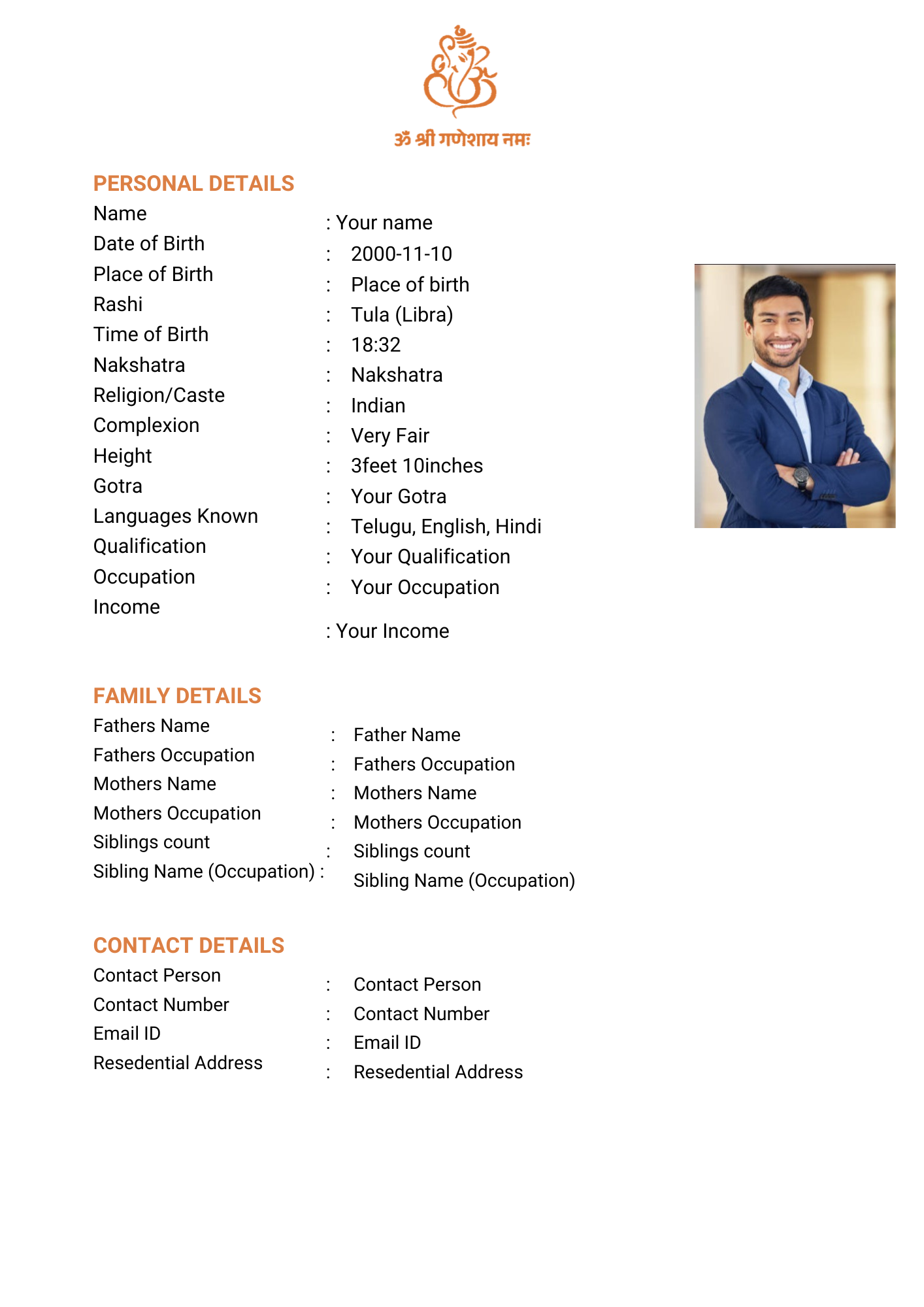
Toran
Mandap arch with garlands
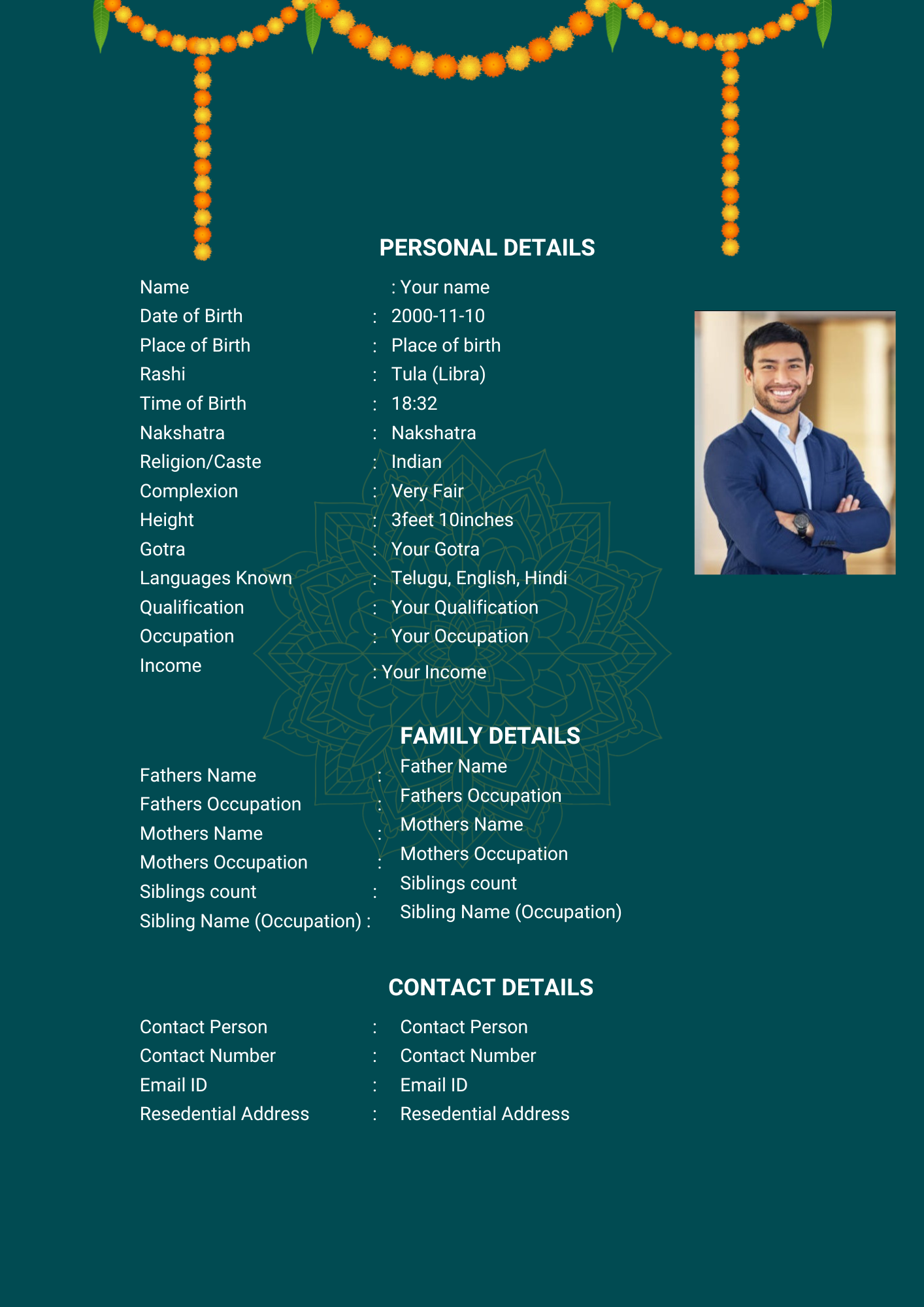
Mandap
Teal arch, hanging marigolds
From First Page to Shubh Muhurat
Where the Biodata Fits in the Journey
In most Hindu families the biodata is the first formal step. Everything that follows depends on this one page being clear and complete.
The biodata goes out
Shared by parents, relatives or the family matchmaker, almost always on WhatsApp. It travels further than you will ever know.
Kundlis are matched
If the page interests the other family, the panditji matches horoscopes using the birth details, Rashi and Nakshatra you provided.
The families meet
Over chai, with questions your biodata has already answered. A complete biodata makes this meeting warmer and shorter.
Roka, and beyond
When both sides agree, the roka or sagai is set for a shubh muhurat. The page that started it all goes into the family album.
The Hindu Marriage Biodata Format, Explained
What makes a biodata Hindu?
The horoscope section. A Hindu marriage biodata carries date, time and place of birth, Rashi, Nakshatra, Gotra and Manglik status near the top, because that is what elders check first for kundli matching. The rest of the page follows the familiar order: personal details, family, contact. Many families also open it with a small deity image or a line like ॥ श्री गणेशाय नमः ॥, which is a matter of taste, not a rule.
There is a reason the page carries this weight. In the Hindu tradition, vivah is one of the sixteen sanskars, a turning point for two families and not just two people. The biodata is the first formal gesture of that joining, which is why even a simple one is written with care.
Personal & horoscope
- Full name and photo
- Date, time & place of birth
- Rashi (moon sign)
- Nakshatra (birth star)
- Gotra
- Manglik status
- Height & complexion
- Diet (pure veg, Jain, non veg)
- Caste & sub caste
- Education, job & income
Family details
- Father's name & occupation
- Mother's name & occupation
- Siblings & their marriages
- Native place
- Family values & traditions
Contact details
- Contact person
- Phone number
- Residential address
- Email (optional)
How to write the horoscope section
Keep it factual and brief. The biodata is not the place for the full janam patrika. Families exchange that separately once there is interest. What the biodata needs is just enough for the panditji to begin kundli milan:
- Birth details: write the exact time and the city of birth, not just the date. Both are needed for matching, and a missing birth time is the most common reason a family calls back with questions.
- Manglik status: use the plain wording families expect: Manglik, Non Manglik, or Anshik Manglik. Do not leave it as a question mark. If your family does not follow this, simply remove the field.
- Gotra: one word is enough. Many communities avoid same gotra matches, so elders look for this line before reading anything else.
- Rashi and Nakshatra: name them as your panditji gave them. The form above has all twelve Rashis in a dropdown so spelling is never a worry.
Sample Hindu Marriage Biodata
Here is how a finished Hindu biodata reads. Notice the order: horoscope details right after the name, work and education next, family before contact. Use it as a reference, then make yours in the form above.
॥ श्री गणेशाय नमः ॥
Ananya Sharma
Date of Birth
14 November 1998
Time & Place of Birth
7:25 AM, Indore, Madhya Pradesh
Rashi / Nakshatra
Tula (Libra) / Swati
Gotra
Bharadwaj
Manglik Status
Non Manglik
Height / Complexion
5' 4" / Fair
Diet
Pure Vegetarian
Education
B.Tech (CSE), IET DAVV, Indore
Occupation
Software Engineer, Infosys, Pune
Father
Shri Rajesh Sharma, retired bank manager, SBI
Mother
Smt. Meena Sharma, homemaker
Siblings
One elder brother, married, settled in Hyderabad
Contact
Shri Rajesh Sharma, +91 98XXX XXXXX
A sample profile. Every line above maps to a field in the maker on this page.
Do
- Write the exact birth time, even the minutes. Kundli milan needs it.
- State diet plainly. Pure vegetarian matters to many families.
- Use Shri and Smt. for parents' names. Elders notice the respect.
- Name the city with the job: 'Software Engineer, Infosys, Pune'.
- Keep it to one page. The kundli travels separately.
Avoid
- Pasting the full janam patrika or planetary charts on the page.
- Leaving Manglik status blank when your family follows matching.
- Salary figures down to the rupee. A range reads with more grace.
- A selfie. Use a clear 3:4 portrait in good light.
- Borrowed phrases like 'homely yet modern'. Write how your family speaks.
Kundli Milan: What the Panditji Checks
Your biodata supplies the inputs, the panditji does the math. In North India the Ashtakoota system scores eight kootas out of 36 gunas, and a match of 18 or more is generally considered acceptable. Knowing what each koota weighs helps you understand the questions that may follow.
| Koota | What it weighs | Gunas |
|---|---|---|
| Varna | Temperament and nature of work | 1 |
| Vashya | Mutual influence and adaptability | 2 |
| Tara | Birth star compatibility and wellbeing | 3 |
| Yoni | Instinct and physical compatibility | 4 |
| Graha Maitri | Mental and intellectual match | 5 |
| Gana | Disposition: deva, manushya or rakshasa | 6 |
| Bhakoot | Emotional bond and family welfare | 7 |
| Nadi | Health and progeny, weighted heaviest | 8 |
Many South Indian families use the 10 porutham system instead, checked against the jathagam. Either way, the biodata only needs accurate birth details. If your family does not follow matching at all, remove the horoscope fields and the page still stands complete.
One Page, Many Names
Every region has its own word for the same one page document. Whatever your family calls it, the contents barely change.
शादी का बायोडाटा
Shaadi ka biodata
Hindi belt
लग्न बायोडाटा
Lagna biodata
Maharashtra
જીવનસાથી બાયોડેટા
Lagna biodata
Gujarat
জীবনবৃত্তান্ত
Biyer biodata
Bengal
పెళ్లి బయోడేటా
Pelli biodata
Telugu states
ஜாதகம்
Jathagam (with the biodata)
Tamil Nadu
Opening the Biodata the Auspicious Way
Many families begin the biodata with a shubh line at the top, the way a wedding card begins. Use the one your own family uses at home, or none at all. All of these are common:
॥ श्री गणेशाय नमः ॥
The most common opening. Ganesha is invoked first in any shubh kaarya.
ॐ
The simplest and most universal. One character, quietly placed.
जय श्री कृष्ण
Common in Vaishnav families, especially in Gujarat and Rajasthan.
जय माता दी
Used by Devi-worshipping families across North India.
What Different Communities Look For
The page is the same, but the line elders read first changes from community to community. A few conventions worth knowing, and when in doubt, ask the eldest person in the house. They will enjoy being asked.
Brahmin families
Gotra is checked first, and some families also state pravara. In the South, the jathagam and porutham matching carry the weight that Ashtakoota carries in the North.
Maratha families
Along with gotra, many Maratha biodatas mention kul and devak, the family's clan and its sacred emblem. If your family observes devak, give it its own line.
Marwari and Bania families
Gotra rules are followed strictly, often on both sides, and diet is read closely. 'Pure vegetarian, no onion and garlic' is a meaningful line in these biodatas.
Rajput families
Vansh and kul come before everything, and many families note their lineage (Suryavanshi, Chandravanshi) along with the clan name. State it the way your elders say it.
Hindu Marriage Biodata FAQs
The Right Fields, the Right Motifs, a Family-Approved Biodata
Fill the form once, try every traditional design, and download your A4 PDF. Free to make, and yours to keep.
Looking for a different community? See the Muslim marriage biodata page